Prices can move against expectations. Historical patterns and indicators do not guarantee future returns. Leveraged products can expose a smaller deposit to a larger position, increasing potential losses.
Costs and execution conditions
Distinguish spreads, commissions and holding costs where applicable. Understand the product structure, potential loss, provider qualifications and relevant terms. A stop order does not guarantee execution at its specified price in every market condition.
What a chart does not establish
Displaying a chart does not demonstrate financial authorization, order execution capability or protection of client funds. This material explains basic concepts and does not replace an individual's investment decision.
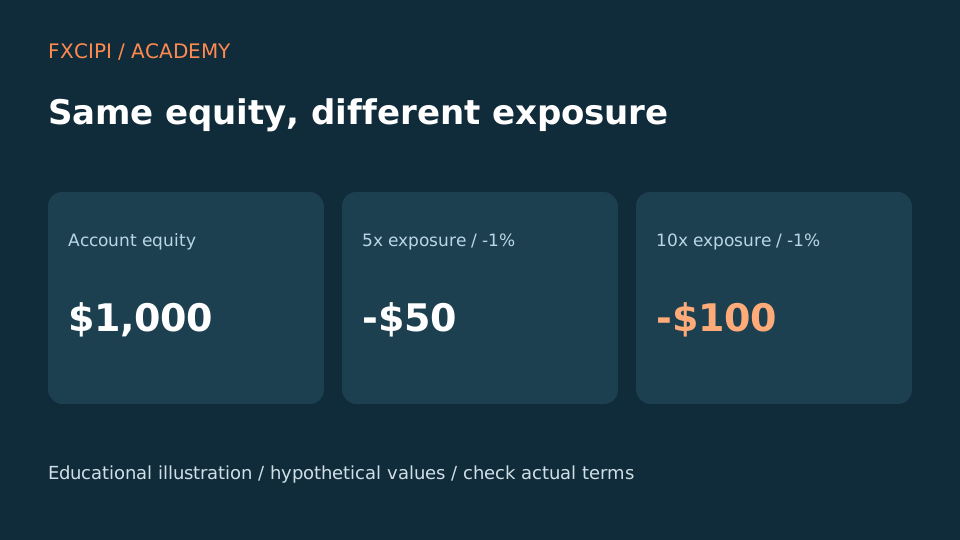
Same equity, different exposure
Assume USD 1,000 equity and a linear long position. Five-times exposure is USD 5,000; ten-times exposure is USD 10,000. A 1% adverse price change produces a loss before costs of USD 50 or USD 100, equal to 5% or 10% of starting equity. A favorable 1% change produces the corresponding pre-cost gain in this simple example. This is not a model for nonlinear products such as options.
Margin is not a maximum loss
Futures margin is collateral supporting contract obligations, not an installment payment for the asset. Initial margin applies when opening a position; maintenance margin is the ongoing requirement. Requirements can change with market conditions or broker policy.
Why a liquidation price cannot be assumed
Account equity, unrealized profit or loss, other positions, fees and provider rules all matter. The inverse of leverage alone does not determine an exact liquidation price. Read rules on collateral calls, liquidation without notice and responsibility for additional losses. Protections differ by jurisdiction, provider and client classification.
Gaps and stop orders
A stop that becomes a market order may fill away from its trigger during a gap. A stop-limit order may remain unfilled. Check contract size, maintenance requirements, liquidation rules and applicable protections before relying on a chart.